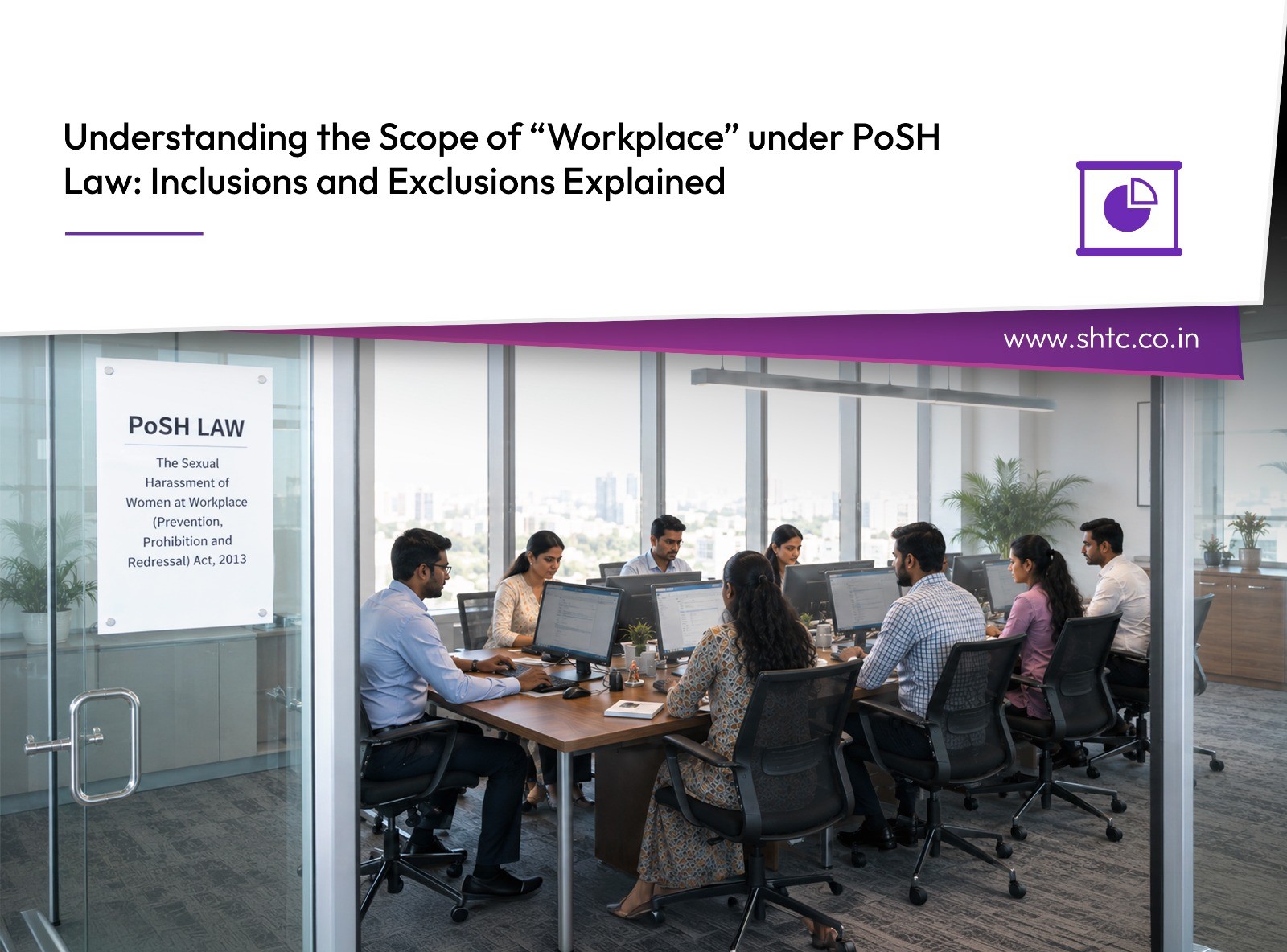
Understanding the Scope of "Workplace" Under the PoSH Act: More Than Just Four Office Walls
Think the Workplace Ends at the Office Door? Think Again.
An employee is harassed while travelling in a company-paid cab after working late.
Is it a PoSH case?
Answering is something that many HR teams are cautious about. The law is clear on it.
According to the Prevention of Sexual Harassment (PoSH) Act of 2013, what constitutes a workplace is not limited to just an office. This may involve customer sites, business travels, commuting on behalf of the business, working from home, and going away on work trips.
However, this aspect of compliance with PoSH is one of the most misunderstood concepts in India.
Many organisations still believe their responsibility ends once an employee leaves the office premises. Unfortunately, this misconception can lead to compliance failures, legal disputes, and reputational damage.
At SHTC, we often see organisations with well-written PoSH policies but an incomplete understanding of what legally qualifies as a workplace. The result? Genuine complaints may be overlooked simply because they occurred outside the office building.
Understanding the scope of a workplace isn't just about complying with the law—it's about creating a safer workplace wherever work happens.
Why the Definition of Workplace Matters
The PoSH Act was designed to protect employees, not buildings.
Rather than where an incident occurred, the law focuses on why the employee was there. If someone is present at a location because of their job or official responsibilities, that place may legally be considered a workplace.
This distinction is critical.
Imagine dismissing a complaint because it happened at a client's office, only to discover later that the incident clearly fell within the scope of the PoSH Act. Apart from legal consequences, such situations can significantly impact employee trust and organisational credibility.
The definition of workplace also plays an important role in Business Responsibility and Sustainability Reporting (BRSR). Under Principle 5, eligible organisations are expected to report workplace safety and sexual harassment complaints accurately. Due to a misperception of their workplace, the firm may end up misclassifying an incident and facing compliance challenges in the course of reporting and audits. Hence, organisations must conduct periodic policy reviews and train their employees, managers and Internal Committee (IC) members on the legal issues involved in real-life cases. At SHTC, we offer PoSH training programmes that include real-life workplace examples and not just legal definitions so that the teams are prepared to face such situations in the future.
What Does the PoSH Act Consider a Workplace?
The workplace under the PoSH Act extends well beyond office premises.
It can include:
-
Corporate and branch offices
-
Manufacturing plants and warehouses
-
Client offices and project sites
-
Vendor and supplier locations
-
Hotels during official travel
-
Company-sponsored events
-
Business conferences and exhibitions
-
Company-provided transport
-
Work-from-home locations
-
Digital platforms used for official communication
A simple way to remember this is:
If work takes the employee there, the PoSH Act may too.
This broader interpretation reflects today's work culture, where meetings happen across cities, teams collaborate remotely, and employees frequently interact outside traditional office spaces.
The "Extended Workplace": A Concept Every Employer Should Understand
One of the biggest compliance mistakes organisations make is assuming that responsibility ends outside office premises.
In reality, the law recognises what is often called the extended workplace.
Consider this example.
An employee visits a client's office for a business meeting and experiences inappropriate behaviour during the visit. Since the employee was there as part of their official duties, the incident may still fall under the PoSH Act even though it happened on someone else's premises.
The same principle applies to business travel, supplier visits, site inspections, official offsites, and industry events.
This is why SHTC encourages organisations to think beyond physical boundaries. Effective PoSH compliance isn't about protecting employees inside four walls—it's about protecting them wherever work takes them.
Does Work From Home Count as a Workplace?
Absolutely.
The shift to hybrid and remote work has undoubtedly changed the locations where employees work, but it has not altered the employer's obligation under the PoSH Act.
In workplaces where employees work from home, the workplace is considered to be at the home itself. Digital media tools used for work, including Microsoft Teams, Zoom, Slack, Google Meet, emails, or other forms of messaging used by an organisation, form part and parcel of the workplace.
Harassment can be committed without presenting yourself in person, and might involve sending unwanted messages, sending offensive emails, contacting employees several times for no valid reason, or behaving incorrectly in virtual meetings.
For organisations practising hybrid work, the PoSH Regulations need to specifically state the requirements in the area of virtual communication and remote work practices. In SHTC, our training courses cover modern work situations, enabling employers and employees alike to learn that the requirement for respect and professionalism at work activities like verbal communications is independent of whether one is in the office or not.
Who Is Protected Under the PoSH Act?
One of the strengths of the PoSH Act is its inclusive approach.
Protection is not limited to permanent employees. It can also extend to:
-
Contract employees
-
Temporary workers
-
Consultants
-
Interns
-
Apprentices
-
Trainees
-
Volunteers
-
Daily wage workers
When it comes to a professional relationship with your corporation, you should ensure that the work environment is hazard-free.
This is why you should not restrict awareness programmes to permanent personnel. Everyone connected with your organisation must be aware of their rights and responsibilities and how the reporting procedures work.
SHTC provides companies with training sessions in PoSH that are tailored to their needs and cover different audience categories, including employees in general, managers, and members of the Internal Committee.
Don't Forget Clients, Vendors, and Business Partners
Now that businesses are not bound to one office, employees have to travel to client sites, suppliers, project venues, conferences, and other business events. Such interaction makes up an essential part of any business operation, but this is also where many companies unknowingly create compliance shortcomings.
An example can be given of an employee facing harassment when visiting a client’s office for business. A complaint about the incident cannot be dismissed simply because it took place outside the premises of a company.
Similarly, inappropriate conduct displayed by employees when talking to a client during a business meeting can influence the organisation’s responsibility.
For these reasons, forward-thinking organisations are expanding the scope of their PoSH policies beyond their internal staff and encouraging respectful behaviour towards their business partners as well.
Common Mistakes Organisations Make
Even organisations with a PoSH policy often overlook practical compliance requirements.
Some of the most common mistakes include:
-
Assuming the office is the only workplace
-
Ignoring incidents during business travel or client visits
-
Excluding remote employees from PoSH awareness programmes
-
Conducting one-time training instead of regular refresher sessions
-
Providing inadequate training to Internal Committee members
-
Failing to maintain proper documentation for audits and investigations
These gaps may seem small, but they can become significant compliance risks when complaints arise.
This is where partnering with an experienced PoSH training provider makes a difference.
How SHTC Helps Organisations Stay Compliant
At SHTC, we believe effective PoSH compliance goes beyond checking legal boxes.
Our approach combines practical training, legal awareness, and compliance readiness to help organisations build safer workplaces.
We support businesses through:
-
Employee PoSH awareness programmes
-
Internal Committee (IC) training
-
Leadership sensitisation workshops
-
Policy review and compliance guidance
-
Refresher training sessions
-
Documentation support for audit readiness
Rather than relying only on legal theory, our programmes use real workplace scenarios, helping employees and managers confidently identify, report, and address inappropriate behaviour before it escalates.
Whether your teams work from offices, project sites, factories, client locations, or remotely, SHTC helps ensure your PoSH framework reflects today's workplace realities.
Final Thoughts
The definition of a workplace has evolved, and every organisation must evolve with it.
Today, work happens in offices, homes, airports, client sites, factories, conference rooms, company cabs, and digital workspaces. The PoSH Act recognises this shift, making it clear that employee safety cannot be limited to four office walls.
For organisations, understanding the true scope of a workplace is more than a compliance requirement it's a commitment to building a respectful, inclusive, and legally compliant work culture.
The question is no longer "Is this our workplace?"
A more effective inquiry is, “Was it the job that brought the employee in?” If the answer to this question is affirmative, it is your organisation’s obligation to act. With appropriate policies, preemptive training, and professional supervision, compliance can go from a mere legal requirement to an element of culture of the company.
At SHTC, we work with companies from all sectors to make this happen with the help of practical PoSH training, internal committee development, and comprehensive assistance with compliance.
Workplaces have evolved. Has your PoSH compliance evolved with them?
Partner with SHTC for comprehensive PoSH training, IC training, policy reviews, and compliance support designed for today's hybrid and distributed workplaces. Get in touch with our experts to build a safer, more compliant organisation.